
Marine AI develops foundation models, visual intelligence, and embodied systems for marine biodiversity, coral restoration, and ocean sustainability.
AI for Coral Reef Monitoring
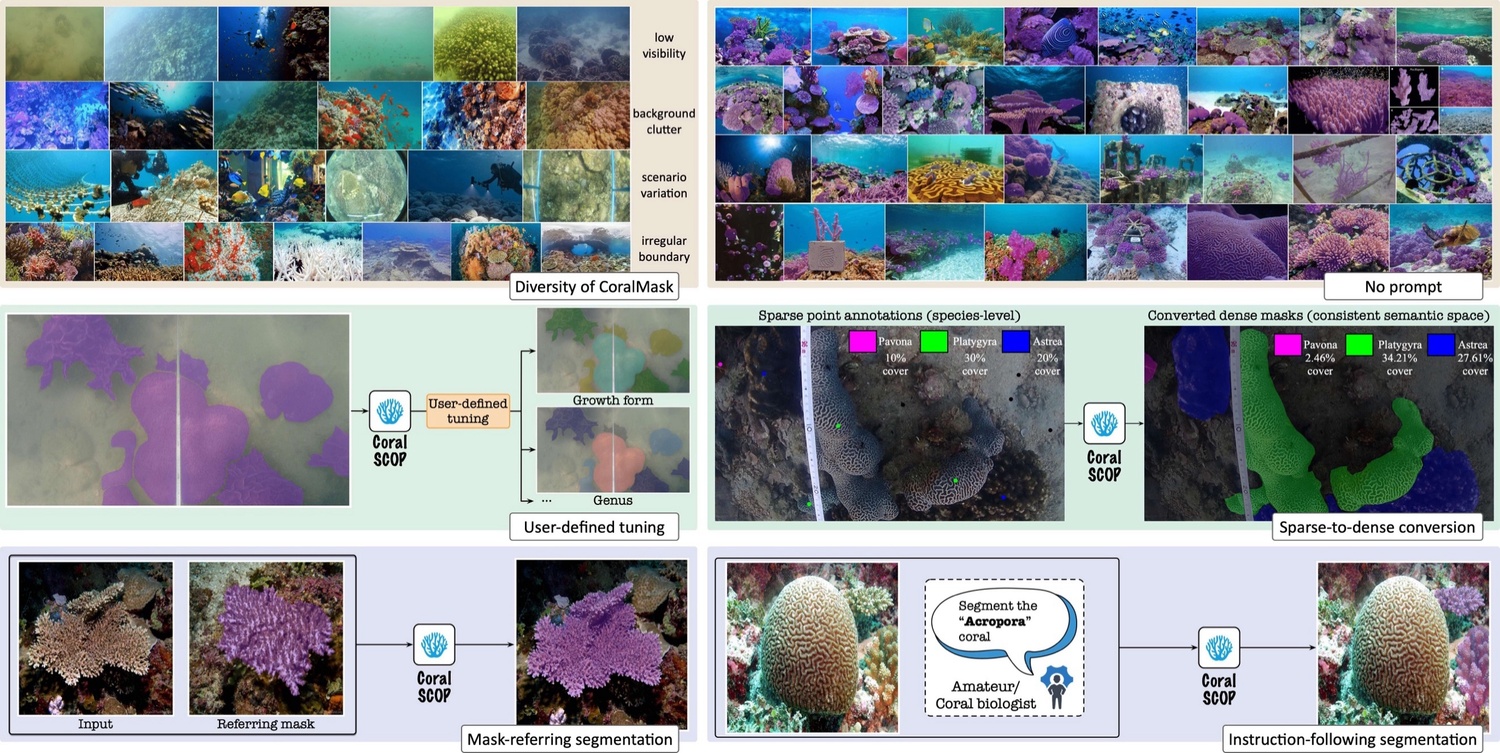
Coral reefs are vital marine ecosystems, but monitoring them at scale remains difficult due to underwater visibility, ecological complexity, and the need for expert annotation. We develop AI systems such as CoralSCOP to segment coral reef images across diverse underwater environments, enabling scalable and fast coral monitoring, health assessment, and restoration support.
Marine Foundation Models for Biodiversity Understanding
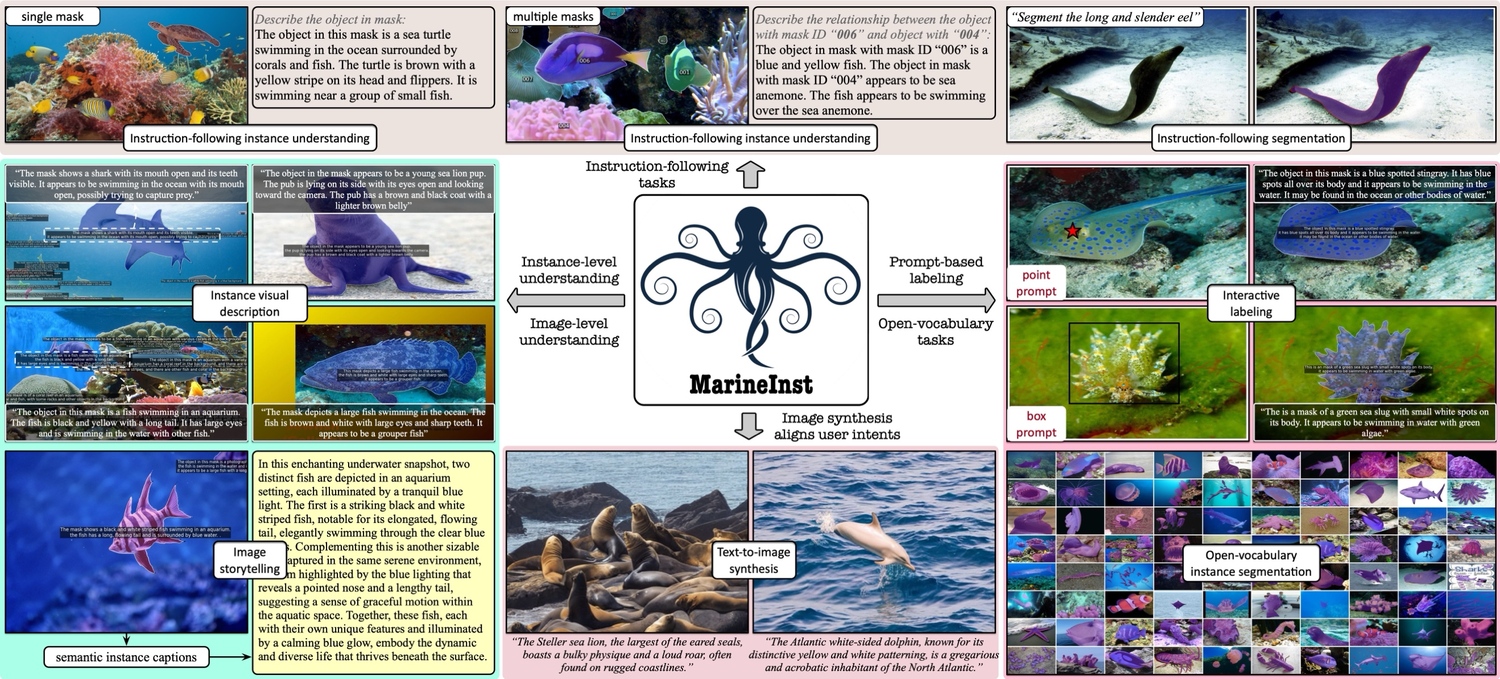
Marine environments contain diverse organisms, habitats, and visual conditions that challenge conventional AI models. We develop marine foundation models such as MarineInst to recognize, segment, and describe individual marine organisms at instance level, supporting biodiversity analysis, ecological interpretation, and AI-assisted marine science.
Advancing AI Agents for Marine Event Analysis
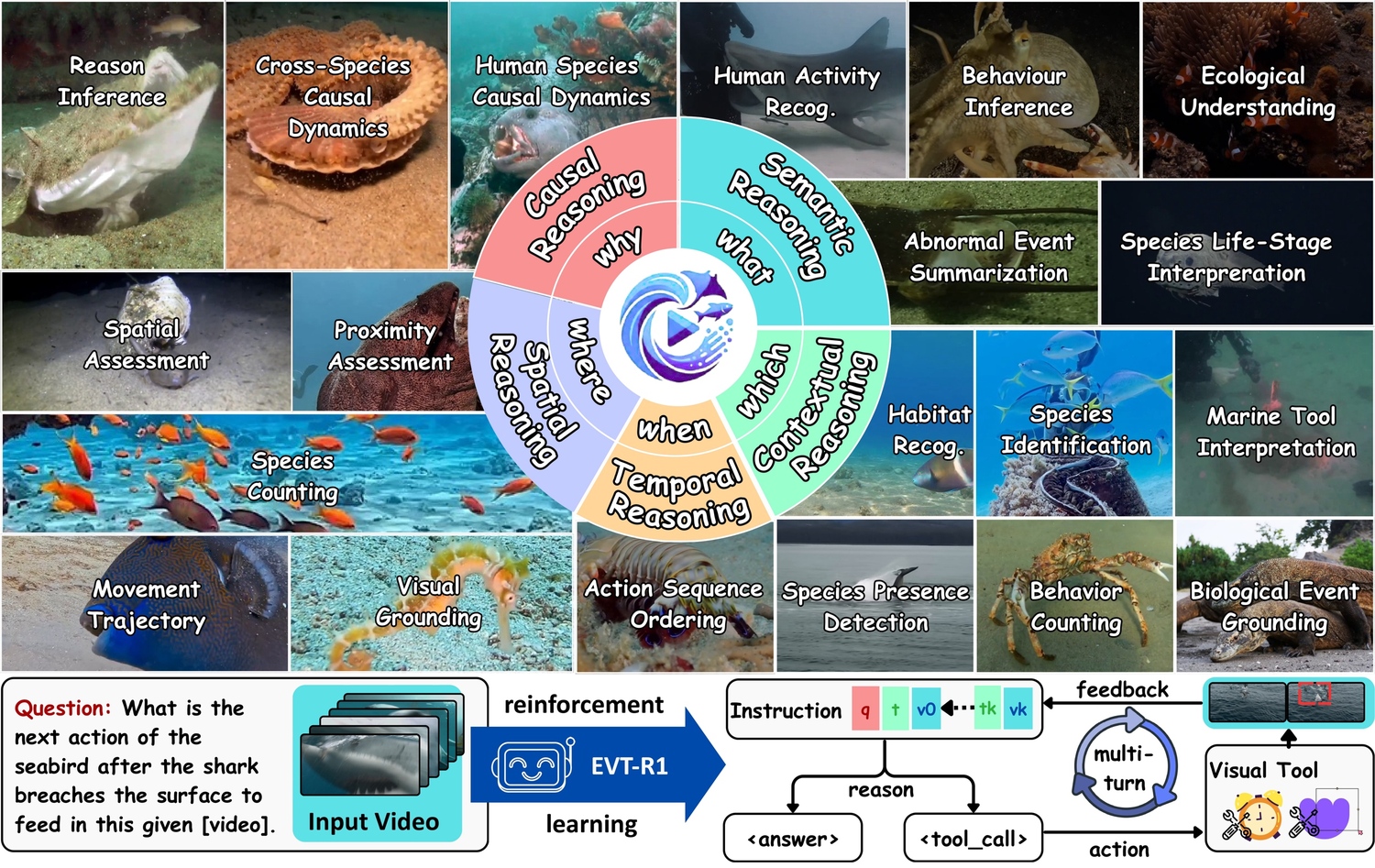
Marine videos contain sparse but meaningful events that general-purpose AI agents often miss, from species interactions to habitat changes and human activities. We develop tool-augmented Marine AI methods that enhance vision-language agents with visual reasoning tools for temporal and spatial grounding, enabling more reliable analysis of underwater videos.
By focusing on event-centric reasoning, this work helps AI agents move beyond scene description toward ecological interpretation, biodiversity monitoring, and long-term marine observation.
Underwater 3D Mapping and Robotic Perception
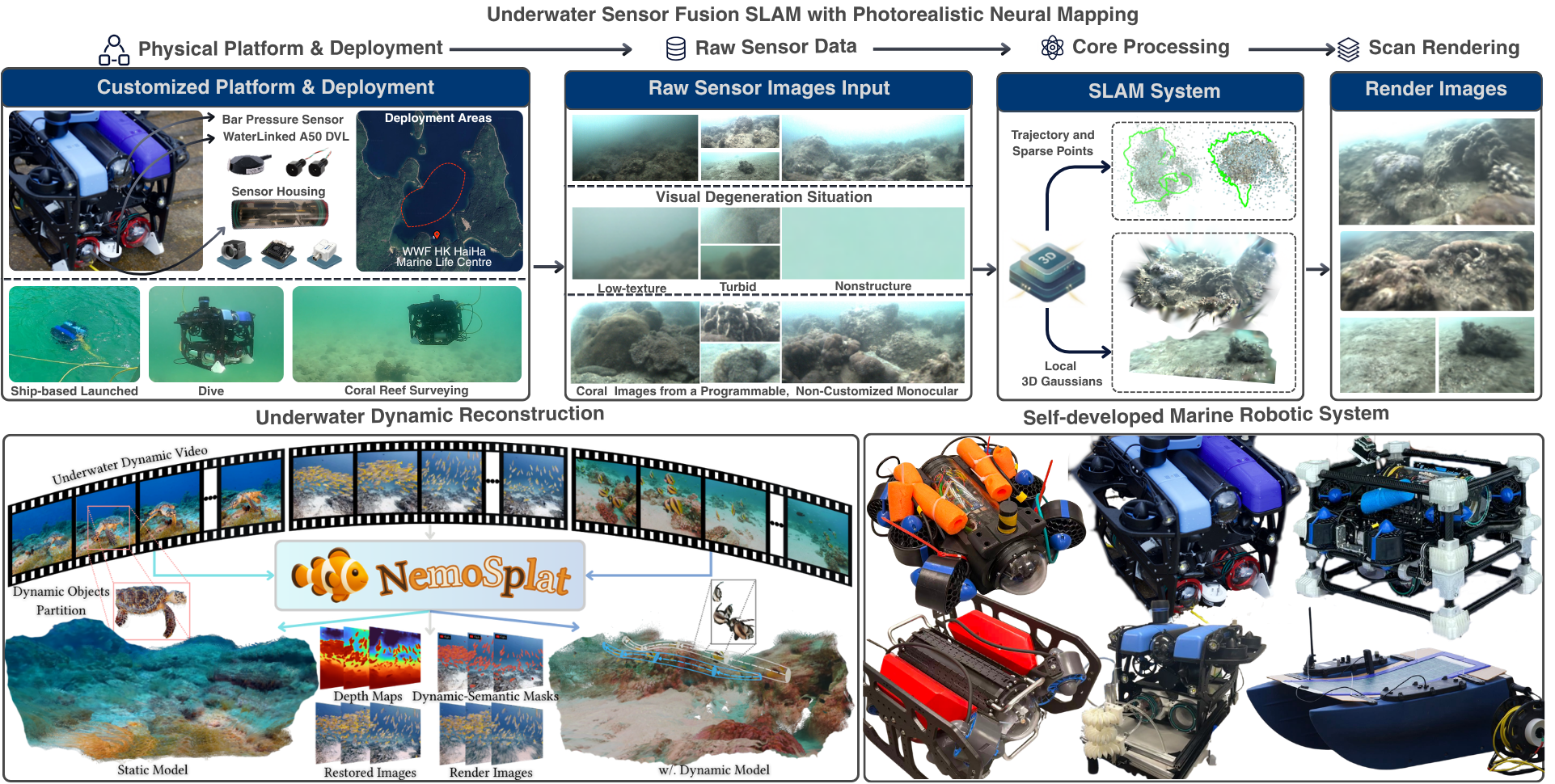
Our research advances Embodied Marine AI by integrating underwater 3D mapping, semantic reconstruction, robotic perception, and Vision-Language-Action (VLA) task planning. We develop AI-enabled underwater autonomous systems that can interpret visual observations, reason with language-guided scientific goals, and translate multimodal understanding into autonomous navigation, sensing, and interaction in complex marine environments.
By combining robust multi-sensor fusion with high-fidelity incremental mapping and semantic scene understanding, these systems provide the spatial intelligence and contextual awareness needed for marine science, habitat monitoring, and ecological modeling. This work bridges AI and the physical ocean, driving innovation in autonomous observation and embodied systems for sustainable ocean science.
AI for Marine Conservation, Tele-Monitoring, and Citizen Science
By turning long-term underwater tele-monitoring video and sensor data into actionable ecological insights, Marine AI can support conservation, restoration, and public engagement. Our Sustainable Smart Campus Pier project integrates underwater cameras, environmental sensors, AI analysis, livestreaming, and modular coral-restoration structures as a real-world testbed. We also collaborate with the WWF-Hong Kong on ghost-net mapping in Hoi Ha and coral-conservation workshops for middle school students, promoting practical conservation, marine education, and citizen science.